Detailed Genealogy and Historical Information
The Michael E. Byczek
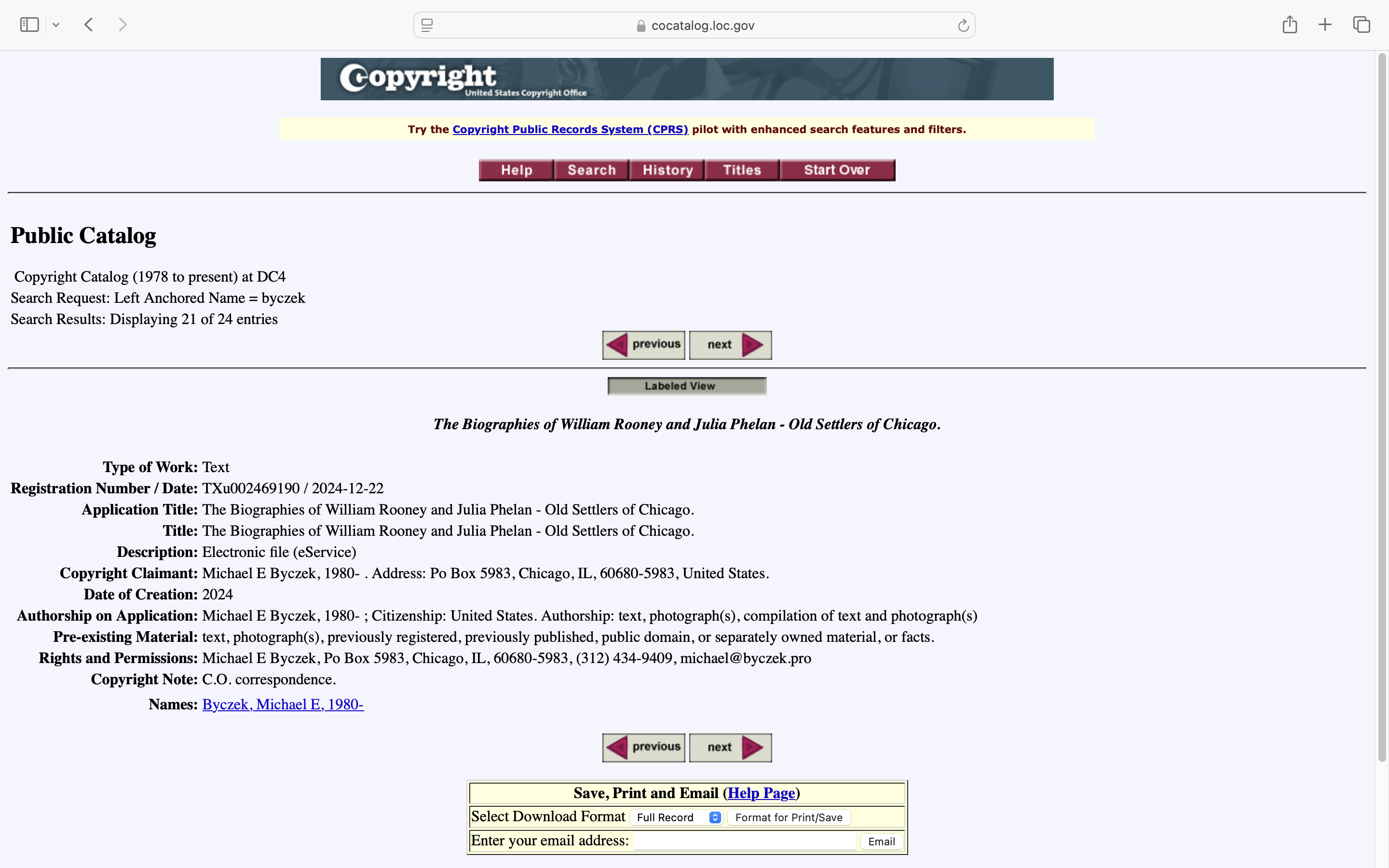
lineage in Chicago, IL is one of the oldest in the city's history dating back to 1835 with his 3x-great-grandparents William and Julia Rooney. He and his parents have conducted extensive historical and genealogical research to preserve these family chronicles since the early 1990s. As an attorney, Michael E. Byczek advocates verified and accurate genealogy through moral-based analysis and ethical historical research. The family has published their genealogy online for almost 30 years with multiple federal copyright registrations (
2012,
2024).
Extensive genealogical and historical biographical documentaries were compiled in PDF format. These biographies are a definitive source of accurate genealogy written by a direct blood descendant. His genealogical research seeks not merely to construct a family tree, but to document the evidentiary reasoning behind it by including the uncertainties that remain.
Parents
- Michael M. Byczek ("Mick") and Betty A. Bykowski live in the Bridgeport neighborhood of Chicago. Their 52nd wedding anniversary took place in September 2026. They were married at St. Helen's in the Ukrainian Village neighborhood in 1974. Mick was born in Bridgeport and Betty in the East Village neighborhood. Mick is an applied physics engineer and an honorably discharged Naval Air Reservist. Betty spent her professional career as an insurance underwriter. They briefly lived in Culver City, California where Mick worked on radar technology. They returned to Chicago and purchased their two-flat in Bridgeport in 1979. Their son Michael E. Byczek was born the following year. Visit mickbyczek.com, bettybyczek.com, and mickandbetty.com.
Grandparents
- Michael S. Byczek and Marie C. Flanagan - 71 Pages
- Roman J. Bykowski and Antoinette A. Murzynowicz/Marynowski - 61 Pages
1x-Great-Grandparents
- Martin Byczek and Maryanna Dudek - 105 Pages
- Martin J. Flanagan and Marie T. Talbot - 91 Pages
- Joseph Bykowski and Margaret Piotrowski - 94 Pages
- Frank Murzyn/Marynowski and Rose Sidor - 92 Pages
2x-Great-Grandparents
- Adalbert Byczek and Catherine Czarny - 26 Pages
- Adalbert Dudek and Victoria Krol - 34 Pages
- Patrick J. Flanagan and Anna Kane - 129 Pages
- Edward H. Talbot and Katherine A. Rooney - 324 Pages
- Lawrence Bykowski and Martha Januszewski - 64 Pages
- Joseph Piotrowski and Victoria Nowakowski - 53 Pages
- Peter Murzyn and Josephine Muracki - 75 Pages
- Frank Sidor and Agnes Gryszkiewicz - 42 Pages
3x-Great-Grandparents
- Jacob Byczek and Catherine Dybas - 49 Pages
- Paul Czarny and Marianna Paluch - 17 Pages
- Gregory Dudek and Marianna Krol - 34 Pages
- Martin Krul and Sophia Maziarka - 37 Pages
- James Flanagan and Bridget Gaharn - 101 Pages
- Patrick Kane and Bridget Rochford - 20 Pages
- Thomas Talbot and Hannah McDonald/McDonnell - 172 Pages
- William Rooney and Julia Phelan - 503 Pages
- Stanley Bykowski and Anna Malek - 71 Pages
- Frank Januszewski and Sophia Sawienski - 85 Pages
- Ignatius Piotrowski and Marciana Zaparucha - 56 Pages
- John Nowakowski and Catherine Kocinski - 48 Pages
- Anthony Murzyn and Elizabeth Zawadzki - 64 Pages
- John Muracki and Marcella Zaskiewicz - 46 Pages
- Lawrence Sidor and Marianna Winikaytys - 55 Pages
- Ambrose Gryszkiewicz and Helena Staskiewicz - 30 Pages
4x-Great-Grandparents
- Joachim Byczek and Lucy Kwilosz - 18 Pages
- Sebastian Dybas and Catherine Nowak - 20 Pages
- Matthias Czarny and Marianna Watroba - 20 Pages
- Martin Paluch and Francisca Stachacz - 4 Pages
- Adalbert Dudek and Apolonia Gil - 40 Pages
- Matthias Krol and Thecla Lepa - 14 Pages
- Simon Krul and Catherine Kaczka - 40 Pages
- Valentine Maziarka and Clara Przybylo - 41 Pages
- Patrick Flanagan and Catherine Casey - 19 Pages
- John Gaharn and Bridget Munford - 17 Pages
- John Talbot and Mary Bourke - 159 Pages
- Hugh Rooney and Alice Dwyer - 110 Pages
- Kasper Bykowski and Margaret Sprinc - 140 Pages
- Adalbert Malek and Agnes Pawelkiewicz - 44 Pages
- Stephen Januszewski and Marianna Kazalowski - 34 Pages
- Vincent Sawienski and Margaret Zielinski - 47 Pages
- Rocco Piotrowski and Agnes Surdinski - 70 Pages
- Paul Zaparucha and Bridget Orlowski - 66 Pages
- Vincent Nowakowski and Hedwig Mordel - 65 Pages
- Valentine Kocinski and Elizabeth Lasocki - 63 Pages
- Matthew Murzyn and Christina Stanialis - 24 Pages
- Paul Zawadzki and Christina Leszczewski - 17 Pages
- Joseph Muracki and Natasha Buchowiecki - 37 Pages
- Stanley Zaskiewicz and Victoria Izbicki - 24 Pages
- Dominick Sidor and Christina Pawlan - 28 Pages
- John Winikaytys and Catherine Mituk - 26 Pages
- John Gryszkiewicz and Regina Niewula - 19 Pages
- Andrew Staskiewicz and Regina Pojawis - 29 Pages
5x-Great-Grandparents
- Thaddeus Kwilosz and Frances Czarnecki - 10 Pages
- Peter and Catherine Dybas - 4 Pages
- Paul Nowak and the Parentage of Catherine Nowak - 4 Pages
- Jacob and Anne Czarny - 4 Pages
- Michael and Margaret Watroba - 5 Pages
- Valentine Gil and Marianna Chebda - 30 Pages
- Philip and Sophia Krol - 42 Pages
- Gasper Lepa and Marianna Lis - 31 Pages
- Thomas and Sophia Kaczka - 16 Pages
- John Maziarka and Eva Czarnawski - 62 Pages
- Frank Przybylo and Barbara Bochenski - 35 Pages
- James Talbot and Catherine Howard - Included with John Talbot and Mary Bourke
- Stanley Malek and Apolonia Kowal - 28 Pages
- Romuald Pawelkiewicz and Hedwig Kostecki - 56 Pages
- Thaddeus Kazalowski and Magdalena Gruzlewski - 10 Pages
- Anthony Sawienski and Maryanna Przybysz - 26 Pages
- Adalbert and Catherine Zielinski - 22 Pages
- Andrew and Marianna Piotrowski - 29 Pages
- John and Marianna Surdinski - 49 Pages
- Thaddeus Zaparucha and Catherine Byczek - 83 Pages
- Paul Orlowski and Ursula Dennicki - 31 Pages
- John Nowakowski and Bridget Metlewicz - 18 Pages
- Joseph Mordel and Margaret Mikolaj - 14 Pages
- Benedict Kocinski and Agnes Kapelak - 15 Pages
- Ignatius Lasocki and Catherine Gorzycki - 17 Pages
- Martin and Christina Murzyn - 114 Pages
- Bartholomew Zawadzki and Eva Kadysz - 46 Pages
- Matthias Leszczewski and Priscilla Koneniewski - 14 Pages
- Adam Buchowiecki and Teresa Masiewicz - 56 Pages
- Michael Zaskiewicz and Marianna Abramowicz - 14 Pages
- Simon Izbicki and Marianna Czuprynski - 19 Pages
- Martin Staskiewicz and Anna Milewski - 19 Pages
- Simon Pojawis and Anna Wolyniec - 15 Pages
6x-Great-Grandparents
- Bartholomew Lis and the Parentage of Marianna Lis - 8 Pages
- Adalbert Przybylo and Frances Mroczek - 119 Pages
- Anthony Bochenski and Sophia Chajec - 41 Pages
- Balthazar and Marianna Surdinski - 34 Pages
- Frank and Rosalie Nowakowski - 11 Pages
- Frank Mordel and Barbara Kosmider - 9 Pages
- Luke Lasocki and Agnes Szucharski - 3 Pages
- Casimir Gorzycki and Helen Kosieta - 9 Pages
7x-Great-Grandparents
- Stanley Bochenski and Agnes Kapelon - 21 Pages
Specialized Documentaries
- World War I - Martin J. Flanagan - 37 Pages
- World War II - Michael S. Byczek - 20 Pages
- Byczek and Dudek Lineage (Land Ownership Analysis in Subcarpathian Voivodeship of Poland) - 142 Pages
Large-scale HTML-based Online Archives
Ethical Historical Research
Michael E. Byczek has conducted genealogical research for more than three decades, combining original church, civil, and historical records with extensive documentary analysis to reconstruct the lives and relationships of his ancestors. His research emphasizes primary-source documentation wherever records survive, while recognizing that earlier generations often require a different approach because records may be incomplete, inaccessible, contradictory, or lost.
Rather than treating every record as unquestionably accurate, he compares information across multiple documents, examines ages, locations, witnesses, godparents, family relationships, naming patterns, and chronological sequences, and evaluates conflicting evidence before reaching a conclusion. When direct documentation is unavailable, he distinguishes documented facts from reasonable inferences and explicitly identifies uncertainties rather than presenting speculation as established fact. His research therefore preserves not only the conclusions reached, but also the evidence, contradictions, assumptions, and limitations that underlie them.
The resulting documentaries are intended to provide a comprehensive record of each direct ancestor and the family relationships surrounding them. Where the evidence permits certainty, the documentation establishes the genealogy directly; where records are incomplete, the research presents the most supportable reconstruction based on the evidence currently available, leaving a clear record that can be tested or refined if previously inaccessible records are discovered in the future. He has been trying to go substantially farther back than the surviving documentation comfortably allows. A carefully qualified conclusion that eventually turns out to be correct is much more valuable than an apparently certain conclusion that was reached by ignoring uncertainty.
Accurate Online Genealogy
Michael E. Byczek does not conduct genealogy to discover or reunite with relatives. With all due respect, he does not seek random communication with genetic cousins or introductory messages. He will not debate research or do work for others. Neither he nor his parents have time to meet relatives, participate in phone/video calls, or engage in back-and-forth communication that requires repetition of what is already available online. It is preferred that unsolicited first-time messages include the URL of a website or social media accounts to put a face to a username (i.e. serious inquiries only). Anybody can send a message claiming to be a relative.
All genealogy and social media platforms pose a risk of cyber-bullying, intimidation, identity theft, fake images/documents (i.e. AI-generated), scams, "bait", social engineering, trolling, slander/libel, misinformation, and other inappropriate online user conduct. Michael E. Byczek's decision to submit a DNA test in the autumn of 2024 was not for genealogy, but to intervene as an attorney. He undertook the exhaustive task to review how his direct blood ancestors were portrayed in the
digital afterlife. The results required an urgent technical and legal solution to restore order on the Internet. At the time, there was a rapid intensification of third-party interference with accurate genealogy. There is a very real risk that artificial intelligence (AI) models are unable to distinguish fact from fiction, truth from fraud, or reliable from unreliable sources.
Michael E. Byczek does not approve any attempt by third-parties or anonymous users to create genealogical profiles or upload content about his deceased direct blood ancestors. Furthermore, he does not support any legal interpretation of constitutional free speech that allows third-parties to anonymously rewrite, erase, or "cancel" history. Nor does he agree with the antiquated viewpoint that the dead don't have rights. His "in the trenches" experience with uncovering fake genealogy was fully documented with screenshots and usernames.
In September 2024, Michael E. Byczek proposed, as an attorney, that community-based genealogy profiles be exclusively and collaboratively administered by direct blood descendants. He created an innovative
framework based on probate procedure. In doing so, he became the first member of any family bloodline to advocate for family-imposed guardrails on these platforms. The framework was withdrawn in June 2026. There was not enough support from others with regard to the risks posed by AI models learning from mis/disinformation or the dangerous precedent of granting anonymous users with unrestricted access to official genealogy profiles that should only be "read only".
A proprietary legal strategy is now underway to permanently protect and safeguard the digital afterlife. An interim blueprint is available at
virtualpedigree.net. The new initiative has strict participation eligibility. The primary objective has always been eternal dignity for the dead, perpetual eradication of inaccurate information on the Internet, and total elimination of all third-party interference. Michael E. Byczek does not approve the format of any genealogy website where he or his parents are treated as equal status to third-parties, anonymous users, or non-blood relatives. Direct blood descendants must always take precedence over all others without exception through a clear blood and generational hierarchy within a family.
In this context, the definition of "third-party" is based on who are legal heirs as defined by applicable probate law. "Anonymous" refers to situations when a verified direct blood descendant of that deceased ancestor is unable to determine the identity of a user. These comments are not meant to imply that all users uploaded questionable content or that all online genealogy is inaccurate. Michael E. Byczek is who he says he is and means what he says he means. As an attorney, he fully documented offensive content, fraudulent genealogy, and identity theft on multiple genealogy platforms. Yet, he is the only member of any bloodline to openly raise awareness and advocate for a solution.
Online Family Trees
It cannot be stressed enough to carefully review usernames and timestamped activity logs to determine credibility and reliability of sources. The
ancestry.com profile with the username "byczek" has a tree identified as
Michael E. Byczek Lineage. The genealogy for this account is DNA-verified for as many generations back as genetic data was available for comparative analysis. Substantial steps were made to stop anonymous users and third-parties on
familysearch.org under the username "michaelbyczek". However, the Family Search platform is community-based where only one profile is allowed per deceased individual. This model allows anonymous third-parties to delete, edit, and modify accurate information (i.e. disruptive editing).
Each deceased individual has a unique profile on Family Search with an assigned identifier, such as his four grandparents:
- Michael S. Byczek (GRRG-GMV)
- Marie C. Flanagan (G5C8-1C2)
- Roman J. Bykowski (GRG3-BXS)
- Antoinette A. Murzynowicz/Marynowski (GRRG-XBB)
As an accurate source of data, a Pedigree Resource File (GEDCOM format) was uploaded to Family Search titled "Michael E. Byczek Lineage" (username of michaelbyczek) to show an outline of his direct-blood ancestors. This information cannot be modified by other users, but the content is displayed in accordance with Family Search parameters (i.e. not all details are publicly visible). The tree can be accessed by searching for the Submission ID: 2:2:2:MMKK-J2F under the option for user-submitted genealogies.
Trees were created on five other sites with various design issues/flaws that enable third-party interference in different ways:
- WikiTree (default username "byczek-85")
- Geni
- MyHeritage
- Geneanet (username "michaelbyczek")
- Findmypast - username "michaelbyczek" without a direct link to the profile.
- The Geneanet, Findmypast, and MyHeritage trees are titled "Michael E. Byczek Lineage".
Grave Memorials
The online platform findagrave.com is dedicated to burial memorials with a model that is similar to Family Search. Only one memorial is allowed per deceased individual. However, the platform grants only one user with administrative control. As a result, this model is also susceptible to anonymous third-parties (i.e. cyber-squatting). Extensive efforts were taken to create over 100 memorials and gain family administration of nearly two dozen that were under third-party control. His
Find a Grave profile provides a link to all memorials under his administration. An initial attempt to administer grave memorials on the website billiongraves.com revealed far too many opportunities for third-party interference due to website design flaws. These efforts were postponed for a future project.
Military Memorials
The fold3.com platform is dedicated to military records with memorials for deceased veterans. Profiles were created for
Michael S. Byczek (Grandfather - World War II) and
Martin J. Flanagan (Great-grandfather - World War I).
More Information
The only genealogy that is approved by Michael E. Byczek and his parents is the content on their own personal family websites, and what is verified to have originated from them on user-uploaded platforms. His father is Michael M. Byczek ("Mick"), mother is Betty A. (Bykowski) Byczek, and sister is Katherine S. Byczek ("Katie").
Main Genealogy Page